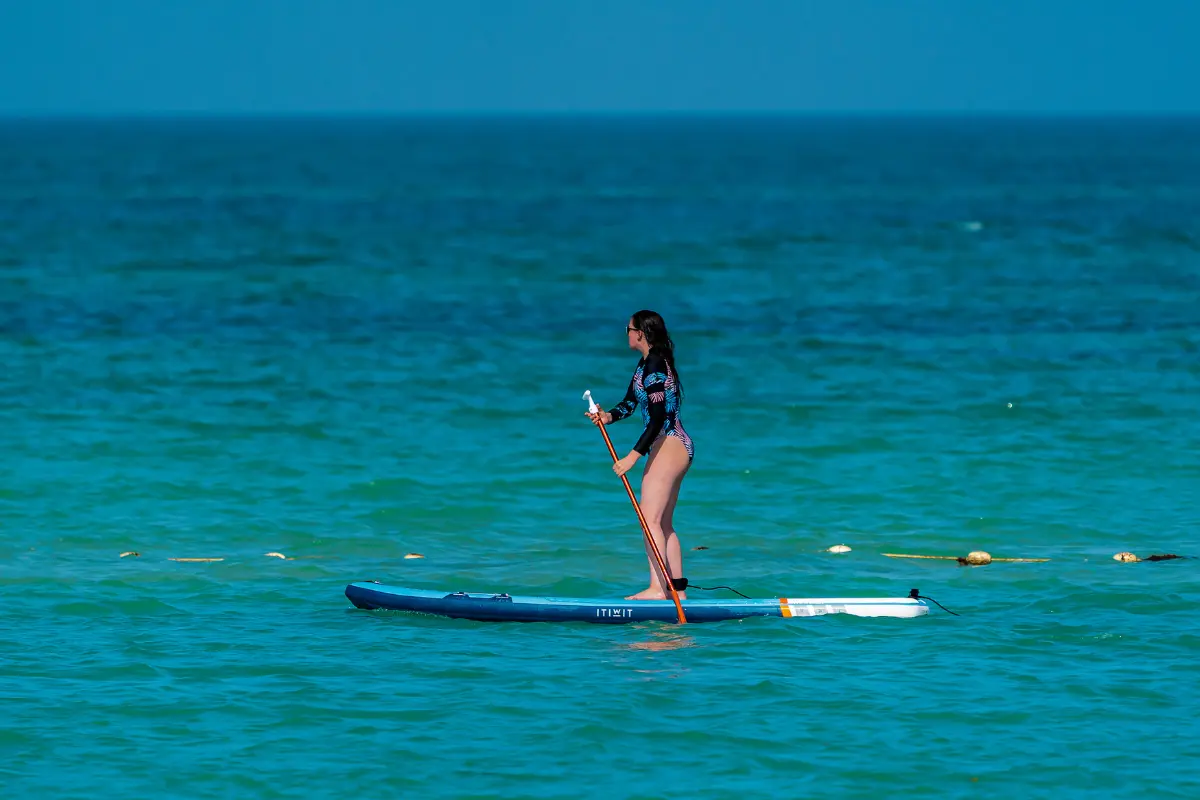
Have you ever seen people standing on a large board in the middle of the sea, holding a paddle, as if they’d discovered the ultimate secret to summer relaxation? Well, that’s SUP (Stand Up Paddleboarding), and it’s very likely to become your new favorite pastime.
And no, you don’t have to be an athlete, have great balance, or be the type of person who surfs two-meter waves. SUP is for almost everyone; all you need is a desire to try something different.
Let’s look at why it’s worth giving it a try this summer.
What is SUP?
SUP is an activity where you stand on a special board and propel yourself using a paddle.
It sounds simple. And, in fact, it is.
You usually start on your knees, get used to the board, and then—when you feel ready—you stand up. And that’s where the magic begins.
Suddenly, you’re a bit higher above the surface of the sea. You can see the bottom more clearly, you experience the air differently, and it feels as though… you’re walking on water. Yes, it sounds a bit like something out of a movie, but it’s true.
Most people manage to stand up much faster than they’d expect.
SUP boards are quite stable and designed with beginners in mind. Even if you fall—which can happen—you’ll likely end up laughing rather than getting upset.
And let’s be honest… it’s summer! A dip in the sea is hardly the worst thing in the world!
Why is SUP so much fun?
You feel like an explorer.
With SUP, you can reach small coves, rock formations, and coastal nooks that you might never have discovered otherwise.
Suddenly, your usual beach takes on a whole new charm. And just like that, your little summer adventure begins. There are moments when you simply stop paddling, sit on your board, listen to the waves, and watch the sun reflecting off the water… SUP helps you slow down—something we all need more than ever.
You’re exercising without even realizing it.
The funny thing about SUP is that you’re having so much fun, you forget you’re actually getting a workout.
To maintain your balance, you engage:
- your core,
- your legs,
- your shoulders,
- your back,
- and even tiny muscles you probably didn’t know you had.
And all of this happens without it ever feeling like a workout.
Is SUP only for athletes?
Not at all! In fact, SUP has become a favorite pastime for people of all ages.
You can do it:
- alone,
- with friends,
- with your partner,
- with your children,
- or even with your dog—provided they’re well-behaved!
Yes, some people go SUPing with their pets, and the photos are every bit as adorable as you’d imagine.
When is the best time for SUP?
For the best experience, try getting up a little earlier. In the morning, the sea is usually calm, the air is fresh, and the feeling is truly unique. SUPing at sunset is just as stunning; the sky changes color, the sea turns into a mirror, and every photo looks like it came straight out of a travel magazine.
A few tips for your first time
- Don’t look at your feet: Look straight ahead—it makes balancing much easier.
- Don’t rush to stand up: Start on your knees and get a feel for the board first.
- Accept that you might fall in: It’s practically part of the experience!
- Don’t try to pull off impressive maneuvers: Save the tricks for later. For now, just focus on enjoying the ride.
Why should you try SUP this summer?
Because SUP isn’t just any water sport. It’s a brief escape from your daily routine—a chance to see the sea through fresh eyes and create unforgettable memories. It’s the joy of exploration when you discover a small cove, the tranquility that comes from drifting with the current while hearing nothing but the sound of the waves—and, of course, the childlike satisfaction of finally managing to stand up on the board for the very first time. And, in all likelihood, the moment you return to the shore, you’ll already be thinking about when you can head back out to sea.
HobbyDetective Spain is preparing its community and experiences. Explore what is coming next. HobbyDetective
Your first step in Spain
Look for an introductory activity near your home and explain your experience level before booking. Confirm details regarding equipment, requirements, insurance, and the policy for bad weather. For outdoor activities, check the specific advisories and restrictions for that location—conditions vary significantly between coastal areas, inland regions, and islands. Choose an activity based on your own preparation and the guidance of professionals, rather than relying solely on a photograph or a difficulty label.
Original article: 2026-06-23. Edition adapted for Spain: 27 October 2026. Read the Greek original. Original author: Eleni Agiou.