Crochet: Where do you begin if you don’t even know how to hold a crochet hook?
Crochet is a creative hobby that you can learn from scratch. And the best part is that you don’t have to start with a huge project or buy a ton of yarn.
With a crochet hook, some yarn, and a few basic techniques, you can take your first steps—gradually moving from a simple chain stitch to your first scarf, a coaster, or even… something even more fun! Let’s look at how to start crocheting, step by step.
What is crochet?
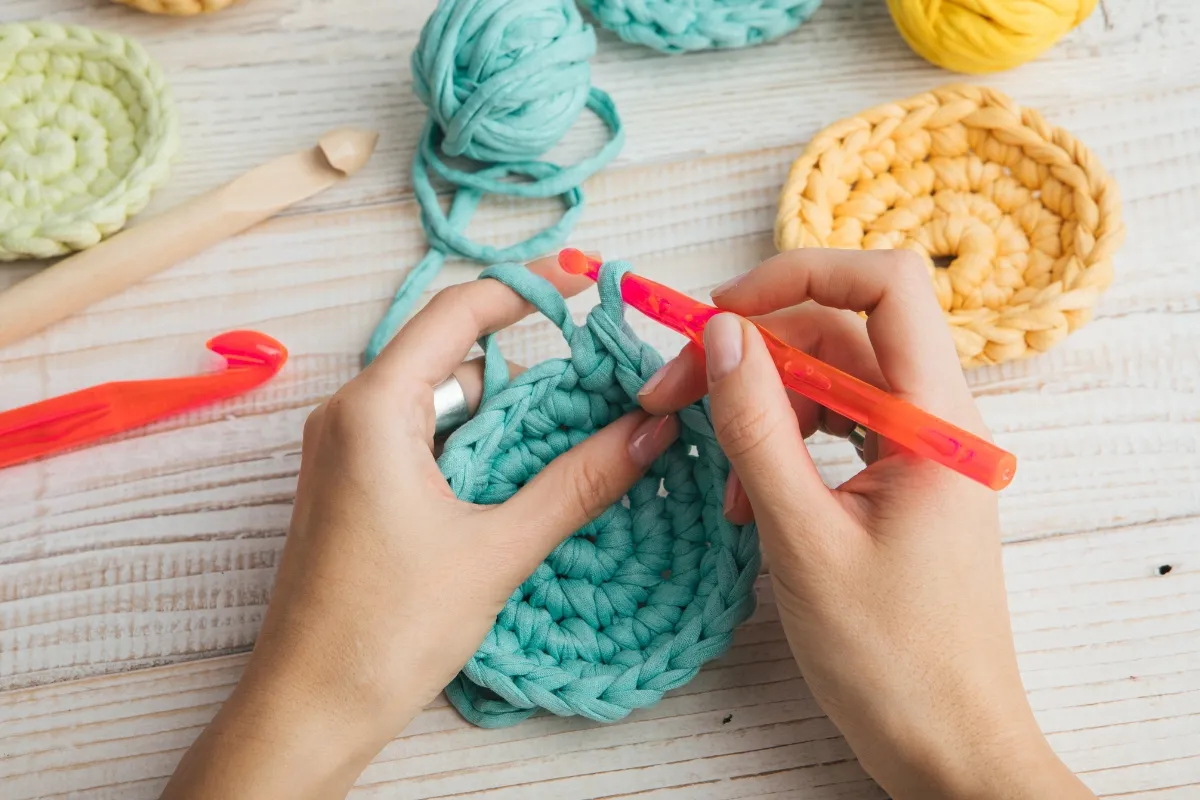
Crochet is a technique for creating textile items using individual stitches and a continuous strand of yarn. Unlike traditional knitting, which typically uses two needles, crochet involves working with a single hook to create a series of interconnected stitches and loops.
You can make almost anything with this technique:
- Scarves
- Hats
- Bags
- Blankets
- Coasters
- Flowers
- Amigurumi
- Decorations
- Clothing and accessories
What do you need to start crocheting?
The good news? You don’t need much.
1. A crochet hook
Crochet hooks come in various sizes, which are chosen based on the thickness of the yarn. For beginners, a medium-sized hook is usually easier to handle than a very thin one.
2. Yarn
For your first project, choose a medium-weight, soft yarn in a light color. Why light-colored? Because when you try to see exactly where a stitch is, a black-colored yarn can become your worst enemy.
3. Scissors
For trimming the ends of the yarn. You don’t need anything special.
4. Darning needle (or tapestry needle)
You’ll need this to weave in the yarn ends once you’ve finished your project.
And that’s it!
How do you hold the crochet hook?
This is one of the first things you’ll need to get used to. You can hold the hook in whatever way feels most comfortable for you; there is no “magical” correct position that you must imitate.
The important thing is to:
- not grip it too tightly,
- be able to move it with ease,
- hold the yarn so that it slides smoothly,
- and, above all, stay comfortable.
At first, it might feel like your hands aren’t quite coordinating yet. That’s completely normal! Don’t give up—you’ll soon find the technique that works best for you.
The 4 basic crochet techniques you need to learn
You don’t need to memorize 25 different stitches before you begin.
To start, focus on the basics.
1. Slip knot
This is where it all begins. You make a loop with the yarn and insert your crochet hook through it to start your first chain.
2. Chain stitch
The chain stitch is one of the most fundamental crochet techniques. You catch the yarn with the crochet hook, pull it through the previous loop, and repeat. And suddenly, you have… a chain. It might not look like much yet, but everything has to start somewhere.
3. Single crochet
The single crochet is one of the basic stitches you’ll see time and again in crochet patterns. It’s perfect for beginners and creates a relatively dense fabric.
4. Double crochet
The double crochet is a taller stitch that creates a lighter, more open texture. Once you start combining different stitches, the possibilities expand significantly.
How do you go about your first crochet project?
I suggest you don’t start with a blouse. Or a blanket. Or a cardigan. And definitely not that huge amigurumi you saved from Pinterest! Start with small projects!
Ideas for a first project:
Coaster
Small, quick, and doesn’t require much precision.
Small flower
Great for practice—and it can later become an embellishment!
Scrunchie
A useful and relatively small project.
Small pouch
A bit more complex, but a great next step.
What do all those strange symbols in crochet patterns mean?
At some point, you’ll open a pattern and see something like: ch 10, sc, sc, sc, inc… and you might think you’ve accidentally stumbled upon some computer code!
Don’t panic! Crochet patterns use abbreviations for the various stitches. Some of the most common ones are:
ch: chain
sc: single crochet
dc: double crochet
sl st: slip stitch
inc: increase
dec: decrease
5 mistakes almost everyone makes when starting to crochet
1. Pulling the yarn too tight
And then they wonder why the hook won’t move!
2. Choosing a first project that is too difficult
Making a huge cardigan as a first project sounds ambitious, but it isn’t necessarily a good idea.
3. Not counting stitches
And so, they start with 20 stitches and finish the row with… 17.
4. Choosing a difficult yarn
A very fuzzy, very thin, or very dark-colored yarn can make things quite difficult for a beginner.
5. Getting frustrated because the first attempt isn’t perfect.
It doesn’t have to be. Your first crochet project is for learning—not for display in a museum.
How long does it take to learn to crochet?
There’s no set timeframe. You can learn the basics quite quickly, but comfort comes with practice. At first, you’ll think about every single movement. After a while, your hands will begin to perform many actions almost automatically.
And at some point in the process, the best part happens: you stop thinking about every individual stitch and simply start creating.
Should you learn to crochet on your own or take a class?
Of course, you can start on your own using books, tutorials, and online classes.
But if you’d prefer someone to show you—up close—how to hold the crochet hook, how to handle the yarn, and what to do when you suddenly… lose three stitches, a beginner’s crochet class can make the process much easier.
HobbyDetective Spain is currently building its community and its catalog of experiences. In the meantime, use these ideas to explore local options and confirm the most up-to-date information directly with each organizer.
Frequently Asked Questions About Crochet
Is crochet easy for beginners?
Yes! Crochet is a hobby you can start with no prior experience. The first steps are relatively simple: you will learn how to hold the crochet hook and the yarn, how to make a slip knot, how to create chains, and how to work a few basic stitches. At first, the most challenging part is coordinating your hands, rather than learning the stitches themselves. With a little practice, the movements become much more natural.
What do I need to start crocheting?
To get started, you will need a crochet hook, suitable yarn, scissors, and a yarn needle (for weaving in ends). If you want to follow a specific pattern, you might also need a few extra tools, such as stitch markers. But there’s no need to buy a huge collection of craft supplies on day one!
Which crochet hook is best for beginners?
A medium-sized crochet hook—around 4–5 mm—is a great choice for beginners, especially when paired with a smooth, medium-weight yarn. The right size depends on the thickness of the yarn and the project you’re working on, so it’s a good idea to check the recommended size on the yarn label.
Which yarn is best for crochet?
For your first projects, choose a smooth, medium-weight yarn in a light color. This makes it easier to see your stitches and understand exactly where to insert your hook. Very thin, fuzzy, or dark-colored yarns can make the learning process a bit more difficult.
What is the easiest crochet project for beginners?
Small, simple projects—such as a coaster, a small flower, a ribbon, or a simple scarf—are great options to start with. An ideal first project is one that allows you to repeat basic stitches without having to navigate complicated instructions.
What is the difference between crochet and knitting?
The main difference lies in the tools used and how the stitches are formed. Crochet typically uses a single crochet hook, whereas knitting generally uses two needles. Both techniques create different textures and involve different methods for constructing stitches; therefore, the choice between them largely depends on personal preference and the type of projects you wish to create.
Can I learn to crochet on my own?
Absolutely. There are many books, video tutorials, and online patterns available to help you learn the basics. However, if you find it difficult to grasp the movements or simply want to practice, a beginner crochet class can make the learning process much easier.
Where can I take crochet classes?
You can look for crochet classes and workshops at craft centers, studios, and schools. At HobbyDetective, you can discover crochet activities and lessons—along with other creative hobbies—depending on what you’d like to try.
Your first step in Spain
Look for an introductory session at workshops or cultural centers in your local area. Compare the techniques being taught, the materials included, the group size, and whether you will be able to complete your piece during the class. If you want to practice at home, start with a small project and purchase only the materials you need; be sure to check the manufacturer’s instructions, as well as the proper ventilation and safety gear required for each product.
Original article: 2026-10-05. Edition adapted for Spain: 27 October 2026. Read the Greek original. Original author: Eleni Agiou.