What is Kendo?
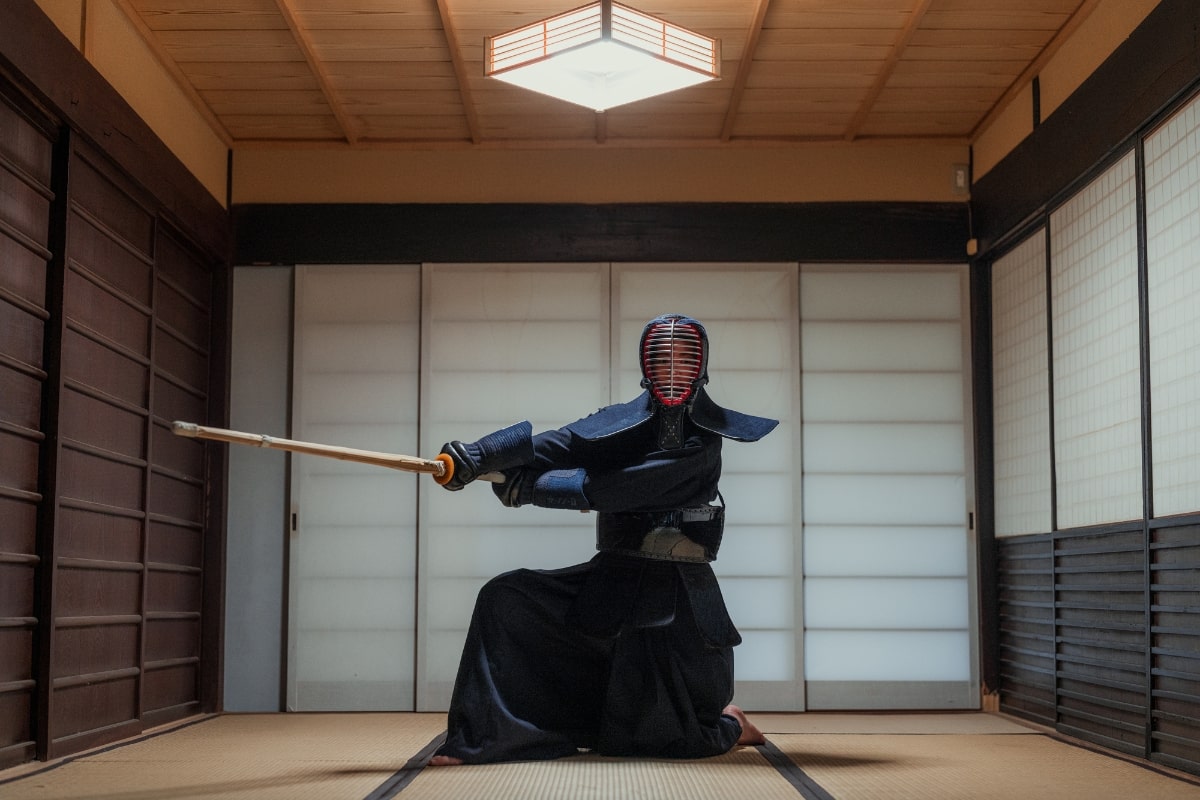
Kendo is a traditional Japanese martial art focused on swordsmanship. The word is derived from the Japanese terms “ken” (sword) and “do” (way or path). It is a path of self-improvement through the practice of swordsmanship.
History of Kendo
Kendo has its roots in Japan’s samurai era. Its swordsmanship techniques were originally developed for practical application on the battlefield. Following the modernization of Japan in 1868, these martial arts evolved into a means for education and personal development.
In 1952, the All Japan Kendo Federation was established to standardize the practice. Today, millions of people around the world practice Kendo.
Kendo Equipment
To begin practicing Kendo, you need:
- Shinai: A bamboo sword used for training.
- Bogu: Protective equipment, including:
- Men: Protection for the head and face.
- Do: Protection for the chest.
- Kote: Protective gloves.
- Tare: Protection for the waist.
- Keikogi: The upper part of the uniform.
- Hakama: The loose-fitting trousers of the uniform.
The shinai consists of four bamboo slats held together by leather components and a cord. Its construction allows for full-contact strikes to be performed safely. It evolved from the *bokken*—a solid wooden sword used by samurai for training.
Kendo Training
Kendo training is structured into several stages:
- *Kihon*: Basic techniques and movements.
- *Kata*: Standardized practice forms using wooden swords.
- *Keiko*: Free-form training with full equipment.
- *Shiai*: Competitions governed by specific rules.
Each training session begins with formal greetings that demonstrate respect for the *dojo*, the instructors, and fellow practitioners.
Techniques and Strikes
In Kendo, there are four primary target areas on an opponent:
- *Men*: The head.
- *Kote*: The wrists.
- *Do*: The torso (chest/midsection).
- *Tsuki*: The throat.
For a strike to be considered valid, it must incorporate the correct posture, distance, timing, and vocal expression (*kiai*).
Fundamental Concepts of Kendo
*Kiai* – Vocal Expression
In Kendo, vocal expression is more than just a shout; it represents the release of energy and is an essential component of every strike. Each strike is accompanied by a vocal announcement of the target: “Men!”, “Kote!”, “Do!”, or “Tsuki!”.
Fumikomi – The Dynamic Strike
Fumikomi is the characteristic strike that accompanies every attack. The sound produced by the fumikomi serves as an audible indicator of the moment of the attack.
Zanshin – The State of Constant Alertness
Zanshin is the state of full awareness maintained after every strike. It demonstrates that one remains alert even after a successful attack. Without zanshin, a technically correct strike is not considered valid in a match.
Seme – The Art of Pressure
*Seme* is an advanced concept in Kendo that describes the ability to exert psychological pressure on an opponent. One can apply pressure through presence and intention, without making any physical movement. Effective *seme* elicits a reaction from the opponent, creating an opportunity for an attack.
Reigi – The Importance of Etiquette
Etiquette in Kendo is of utmost importance and deeply symbolic. Every aspect of this art—from the bows at the beginning and end of each match to the way one wears the *hakama*—is intended to cultivate respect.
The way one handles equipment reflects one’s character. In traditional Kendo, equipment is considered an extension of the self, and caring for it is an integral part of the practice.
Nihon Kendo Kata – The Soul of Kendo
The classical Kendo *kata* form the soul of this martial art and consist of 10 standard forms performed with a *bokken* (wooden sword). Through them, ancient samurai techniques and the profound philosophy underlying each movement are passed down.
Each *kata* is performed by two individuals with specific roles: the *uchidachi* (the teacher/senior), who typically receives the attack, and the *shidachi* (the student/junior), who responds with the appropriate technique. Practicing *kata* provides a deeper understanding of Kendo—one that cannot be attained solely through sparring with a *shinai*.
The first *kata* teaches the fundamental strike to the head, while subsequent *kata* develop more complex techniques and principles. Practicing them requires concentration, precision, and a profound grasp of what it feels like to engage in combat with a real sword.
Relationship with other martial arts
Kendo is closely related to *iaido*—the art of drawing the sword rapidly—and *jodo*—the art of the staff. Many kendo practitioners also engage in these arts concurrently to gain a more comprehensive understanding of sword techniques.
Differences between Japanese and Western styles
There are slight differences in the practice of kendo in Japan compared to the West. In Japan, greater emphasis is placed on tradition and ritual, whereas in the West, more attention is sometimes given to the athletic aspect.
Nevertheless, the International Kendo Federation works to standardize the practice globally, while preserving the authenticity of the art.
How to get started with kendo in Spain
In Spain, consult the club directory provided by the Royal Spanish Judo and Associated Sports Federation and verify the information with the specific club and the relevant regional federation. The directory includes disciplines such as kendo and aikido; confirm directly whether beginner classes are offered, who teaches them, and what requirements apply.
Inquire about a trial session, the availability of loaner equipment, insurance coverage, and the criteria for advancement. A description of the style on a website is not enough to evaluate a school; observe how techniques are explained and how the training is adapted for beginners.
Benefits of Practicing Kendo
The systematic practice of Kendo offers multiple benefits that extend beyond the dojo:
Physical Benefits
- Improved cardiovascular endurance through intense training
- Development of strength in the legs and body
- Enhanced agility and reflexes
- Better hand-eye-foot coordination
Mental Benefits
- Cultivation of concentration and clarity
- Development of the ability to make decisions under pressure
- Improved spatial and temporal awareness
- Strengthening of mental fortitude
Psychological Benefits
- Cultivating self-discipline and perseverance
- Managing stress and emotions
- Developing self-confidence
- Adopting the values of respect and humility
How to Get Started
To begin your Kendo journey:
- Look for a Kendo dojo or club in your area and verify its details through the official federation directory and by contacting the center directly.
- Attend a training session as an observer to get an idea of what it’s like.
- Speak with the instructor in charge (sensei) about the requirements and the program.
- Acquire the basic equipment: initially, you only need a *shinai* (bamboo sword) and the appropriate clothing.
- Commit to training regularly: consistency is key. To make progress
During the first few months, you will practice basic movements and postures without protective gear. This period is crucial for developing proper technique and posture. Only once you have mastered the basics will you move on to training with full equipment (*bogu*).
Ranks and Progression
The ranking system in Kendo consists of *kyu* and *dan* grades:
- *Kyu* grades (from 6th to 1st) represent entry-level ranks.
- *Dan* grades (from 1st to 8th) represent advanced ranks.
Advancing to each new rank requires examinations that include the demonstration of techniques, knowledge of *kata*, and competitive ability.
The Philosophy of Kendo
Kendo is more than just a martial art. It is a way of life that teaches values such as:
- Honesty (*Makoto*)
- Courage (*Yuki*)
- Courtesy (*Rei*)
- Honor (*Meiyo*)
- Self-control (*Jisei*)
Through continuous practice, you develop character and spiritual strength that can be applied to all aspects of your life.
Kendo in Your Life
Kendo combines technical practice with spiritual cultivation, offering a path of personal growth that extends far beyond the *dojo*.
In a fast-paced era, Kendo teaches the value of patience, perseverance, and respect. It provides you with the tools for continuous self-improvement in your daily life.
Regardless of your age or physical condition, you can begin practicing Kendo and enjoy its benefits. Many practitioners continue for decades, as Kendo is an art that can be practiced throughout one’s entire life.
The great value of Kendo lies in its timeless nature: the same principles that guided the samurai centuries ago remain relevant and useful in modern life.
Your first step in Spain
Look for an introductory session at workshops or cultural centers in your municipality. Compare the techniques being taught, the materials included, the group size, and whether you will be able to complete the project during the class. If practicing at home, start with a small project and purchase only the necessary materials; always check the manufacturer’s instructions, and ensure proper ventilation and the use of appropriate protective gear for each product.
Original article: 2025-05-17. Edition adapted for Spain: 27 October 2026. Read the Greek original. Original author: Eleni Agiou.