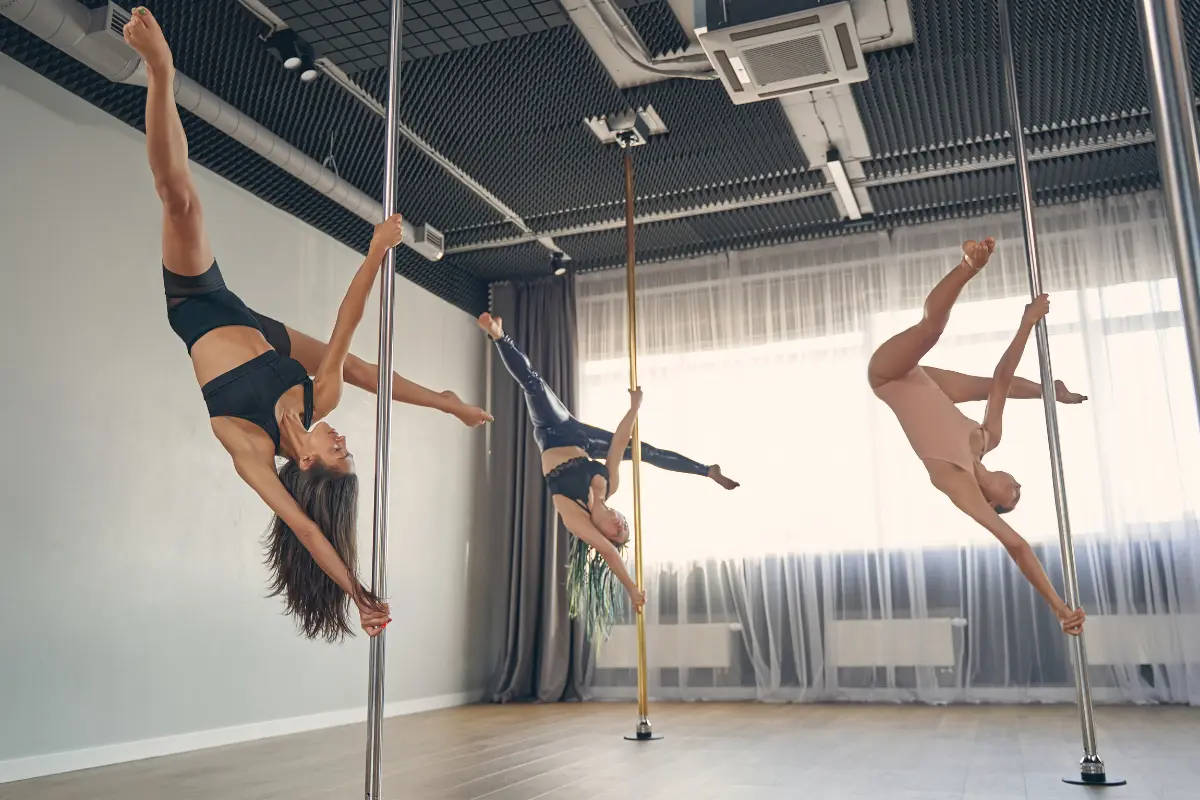
If you’ve heard of pole dance, you likely already have an image in mind: a pole, impressive spins, aerial poses, and people who seem to defy gravity.
But pole dance is much more than that.
Today, it encompasses dance, physical activity, acrobatic art, and competitive sport. Depending on the class you choose, you might focus more on strength and technique, choreography and expression, or a combination of all these elements.
Is it dance or gymnastics? The short answer is: it can be both.
What exactly is pole dance?
Pole dance combines elements of dance, acrobatics, strength training, flexibility, and body control. In a single session, you might practice spins, climbs, poses, inversions, transitions, and choreography. And here’s an important detail: there isn’t just one type of pole. Depending on the class and your personal goals, the experience can vary significantly.
Pole Fitness: When the focus is on strength
If you are primarily interested in the gymnastic side of things, there is Pole Fitness. Here, the emphasis is placed more on physical conditioning and the technical execution of movements. These exercises specifically target grip strength, the upper body, and the core, while also requiring coordination and body control. The interesting thing is that many exercises use your own body as resistance.
You can start with simple spins and basic strengthening exercises and gradually move on to more demanding movements.
So, if you think pole dance is just “doing a few spins and that’s it,” there is likely much more for you to discover.
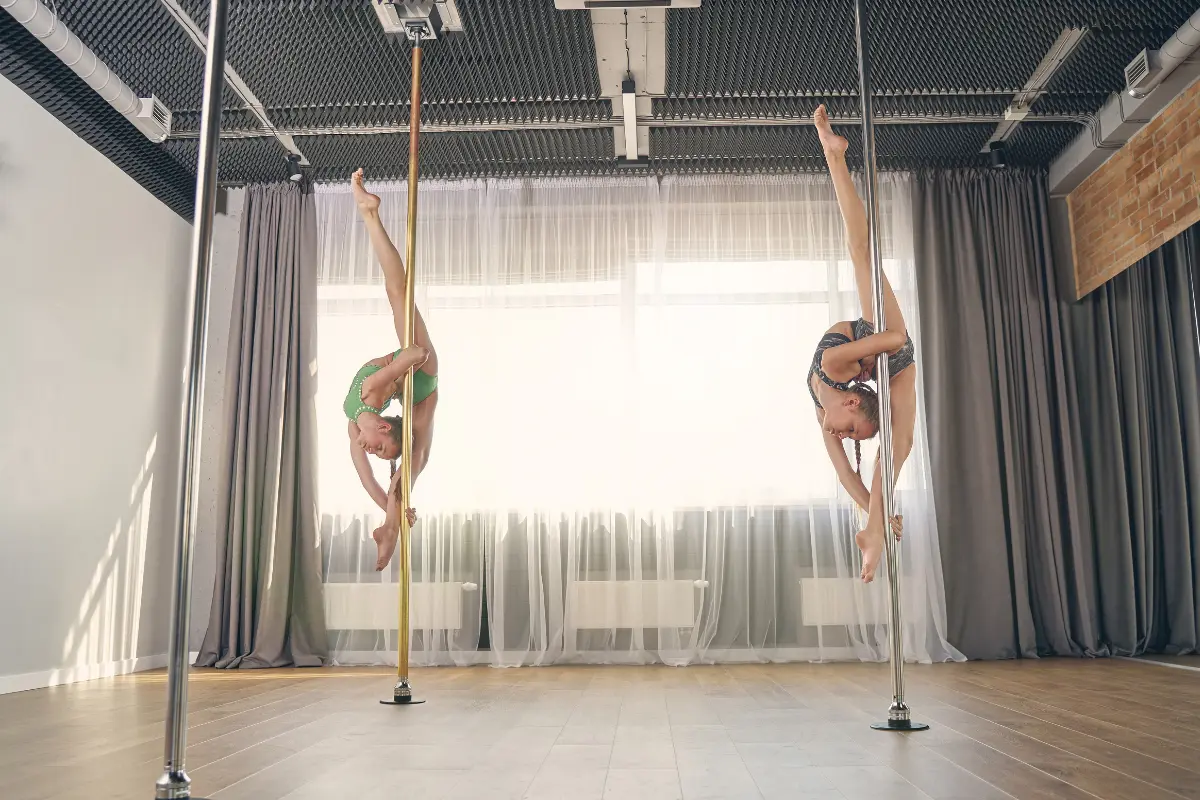
Pole Dance: when the dance element takes center stage
This is where the dance aspect begins to become more apparent. In pole dance, movements on the pole can be combined with choreography, music, transitions, and floorwork. It’s not just about whether you can perform a difficult move, but also about how you connect those movements to create a complete performance.
This means that two people can practice pole dance and have completely different experiences. One might love tricks and acrobatic moves, while the other might enjoy the music, choreography, and expression more.
And then there is Artistic Pole.
Artistic Pole places even greater emphasis on the artistic aspect of the performance. Music, movement, expression, and creativity play a significant role, and various dance styles and acrobatic elements can be incorporated.
In fact, Artistic Pole is a distinct competitive discipline within the International Pole Sports Federation. So, if someone tells you that pole is “just gymnastics,” they likely haven’t seen the full scope of this activity.
And what about Exotic Pole?
Here is another option. Exotic Pole features a more sensual aesthetic and emphasizes floorwork, transitions, choreography, and—in some styles—the use of high heels.
It differs from Pole Fitness and competitive pole, and is geared toward those who wish to explore the expressive and dance-oriented side of pole.
What do you train when practicing pole?
This is perhaps the point that surprises beginners the most. To hold your body on the pole, you need strength and control.
Grip strength and upper-body strength are particularly important, while many movements require significant core engagement and well-coordinated use of multiple muscle groups. The activity also demands muscular endurance, coordination, and flexibility.
And there is something that isn’t easily apparent from the outside:
Technique is just as important as strength.
Being strong isn’t enough. You need to know how to use your body—where to place your weight, how to maintain the correct position, and how to transition from one movement to the next. That is why making progress on the pole can be so rewarding. At some point, a move that once seemed impossible becomes possible.
What are spins, tricks, and inversions?
If you start looking for information about pole dancing, you will soon come across a few specific terms.
Spins: rotations around the pole.
Tricks: specific techniques or poses performed on or around the pole.
Climbs: ascending the pole using your hands and feet.
Inversions: upside-down positions where your body is inverted.
Transitions: movements that connect two different poses or positions.
Floorwork: movements and choreography performed on the floor.
As you progress, these elements begin to combine, creating more complex sequences and choreography.
Do you think you lack the necessary strength?
This is perhaps one of the most common concerns people have before trying pole dance. You don’t need to be able to perform an impressive aerial move on your very first day. Beginner classes start with basic movements and help you get familiar with the equipment; the level of difficulty then increases gradually.
Why is so little clothing worn in these classes?
There is a practical reason for this. In pole dance, your skin helps create the friction needed to hold onto the pole for many moves and poses. For this reason, classes are typically taught in attire that leaves certain parts of the body exposed.
It is not necessarily about appearance or aesthetics; it is about technique and grip.
Naturally, the appropriate attire varies depending on the type of class and the school’s guidelines.
So, in the end… is it dance or gymnastics?
It depends on how you choose to approach it.
If you opt for Pole Fitness, you will focus more on strength and physical conditioning. By choosing Pole Dance, you will combine technical movements with choreography and music. If you are interested in Artistic Pole, you will explore the artistic and expressive side more deeply.
If you are interested in Pole Sports, you will enter a more purely competitive environment, governed by specific rules and technical criteria.
And this is perhaps the best aspect of pole dance: You don’t have to pigeonhole the activity into a single category.
Beyond physical exercise, pole dance helps you develop skills such as concentration, coordination, balance, strength, and body control. But there is more to it. The moment you manage to execute a move that, just a few weeks earlier, you couldn’t have even imagined doing—that in itself is a small victory.
And perhaps that is one of the reasons why pole dance can become so addictive.
You don’t need to be a dancer, an athlete, or in peak physical condition to try it for the first time. You just need to find a class that suits your level and start with the basics! Because pole dance is about more than just learning to perform impressive moves. You’ll gradually discover what your body is truly capable of!
HobbyDetective Spain is currently building its community and catalog of experiences. In the meantime, use these ideas to explore local options, and be sure to verify the latest details directly with each organizer.
Your first step in Spain
Check out schools, associations, and cultural centers in your area. Ask if you can attend a trial session, and confirm the language, skill level, schedule, and any required equipment. If you’re planning to attend a show or a meetup, check the current schedule and terms. When starting a new hobby, it’s usually better to find an activity you can repeat regularly, rather than buying equipment or committing to a long-term course right from the start.
Original article: 2026-09-21. Edition adapted for Spain: 27 October 2026. Read the Greek original. Original author: Eleni Agiou.