There is something uniquely beautiful about taking a simple piece of wood and—with a few tools and plenty of patience—transforming it into something you’ve created yourself. That, in essence, is woodcarving.
It’s a hobby that blends craftsmanship, creativity, and technique, giving you the chance to work with a natural material—literally with your own hands. The best part is that you don’t have to start by creating complex sculptures; the process can begin with something as simple as a drawing on a small piece of wood.
From there, the transformation begins.
What exactly is woodcarving?
Woodcarving is the process of gradually removing material from a piece of wood using specialized tools to create a design, a decorative object, or even a full-scale sculpture.
Unlike other crafts, where material is added to create something, here the process works in reverse:
You start with a piece of wood and remove what isn’t needed.
And that is what makes the process so interesting. Every cut is, in essence, a decision.
Not all woods are the same.
One of the first things you learn in woodcarving is that the choice of wood matters. There are softwoods and hardwoods, and each behaves differently when worked. For example, linden (basswood) is widely used in woodcarving—especially by beginners—because it is relatively soft and easy to work with. Pine can also be used, but its harder, resinous sections can make the cutting process less predictable.
Other woods, such as oak, walnut, or beech, are harder and can yield excellent results, but they generally require more physical strength and better control of one’s tools.
So, it’s not enough to just grab “a piece of wood.” You choose your material based on what you want to create and the technique you intend to use.
What can you make?
And here is perhaps the best part: woodcarving doesn’t necessarily mean creating a large statue. You can start with small, practical items, such as:
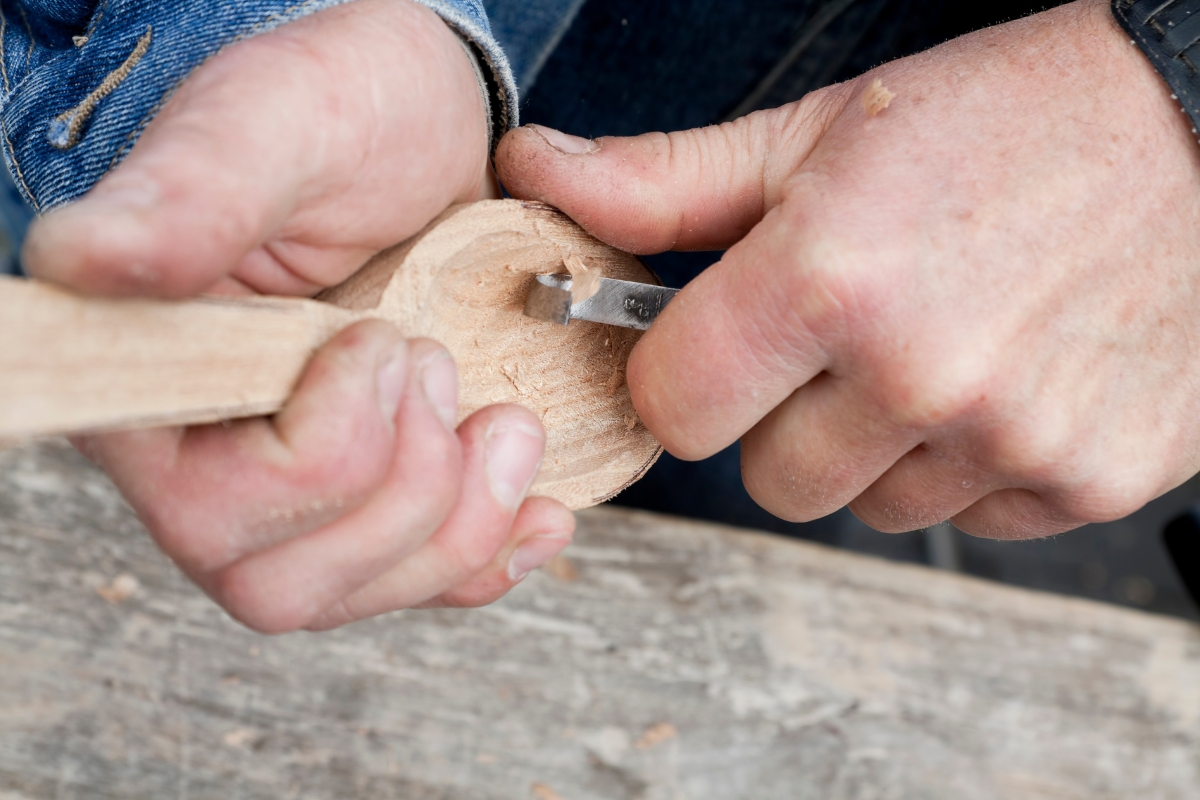
- Wooden spoons
- Small ornaments
- Animal figurines
- Relief designs
- Decorative panels
- Keychains
- Small boxes
- Wall decorations
- Small figures
- Functional wooden objects
And as you gain experience, you can move on to more complex constructions and sculptures!
How do you start woodcarving?
Before you begin working, there is usually a design.
It could be a drawing of your own or a pre-made pattern. The design is transferred onto the wood, and then the process of removing material begins. In a relief, for example, you might first remove wood around the basic design to create depth. Then, you work on the details. The key is not to try to reach the final result all at once.
Woodcarving is a gradual process. You remove a little bit. You observe. You make adjustments. You remove a little more. And then you observe again.
What tools are used?
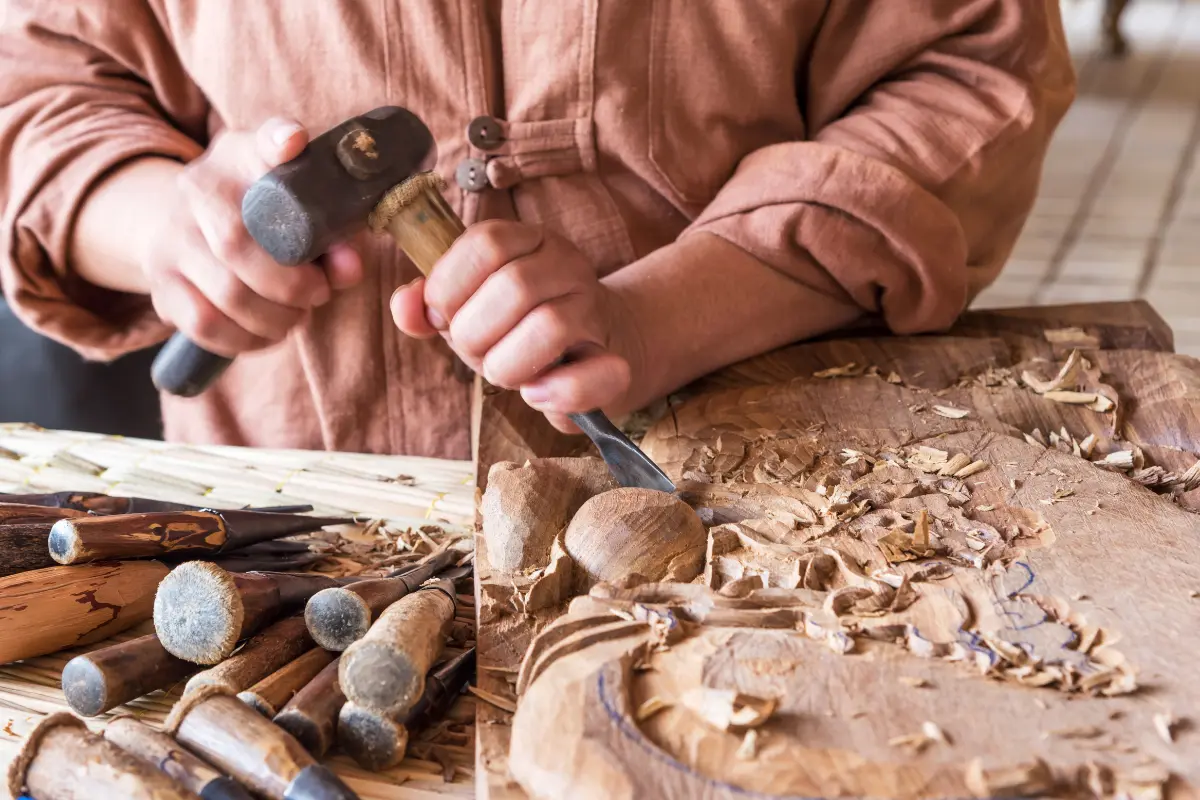
In general, the tools used in woodcarving include:
Chisels
These come in various shapes and sizes and are used to remove wood and create details.
Carving knives
Small, specialized knives designed for woodcarving, used primarily for smaller projects and detailed cuts.
Wooden mallet
Used with certain chisels when greater force is required to remove material.
Saws
These can be used to give a piece of wood its initial shape.
Sandpaper
Used for the final finish and for smoothing specific surfaces, depending on the project.
And, of course, sharp tools require proper use and safety precautions. Learning the correct technique is very important, especially for a beginner.
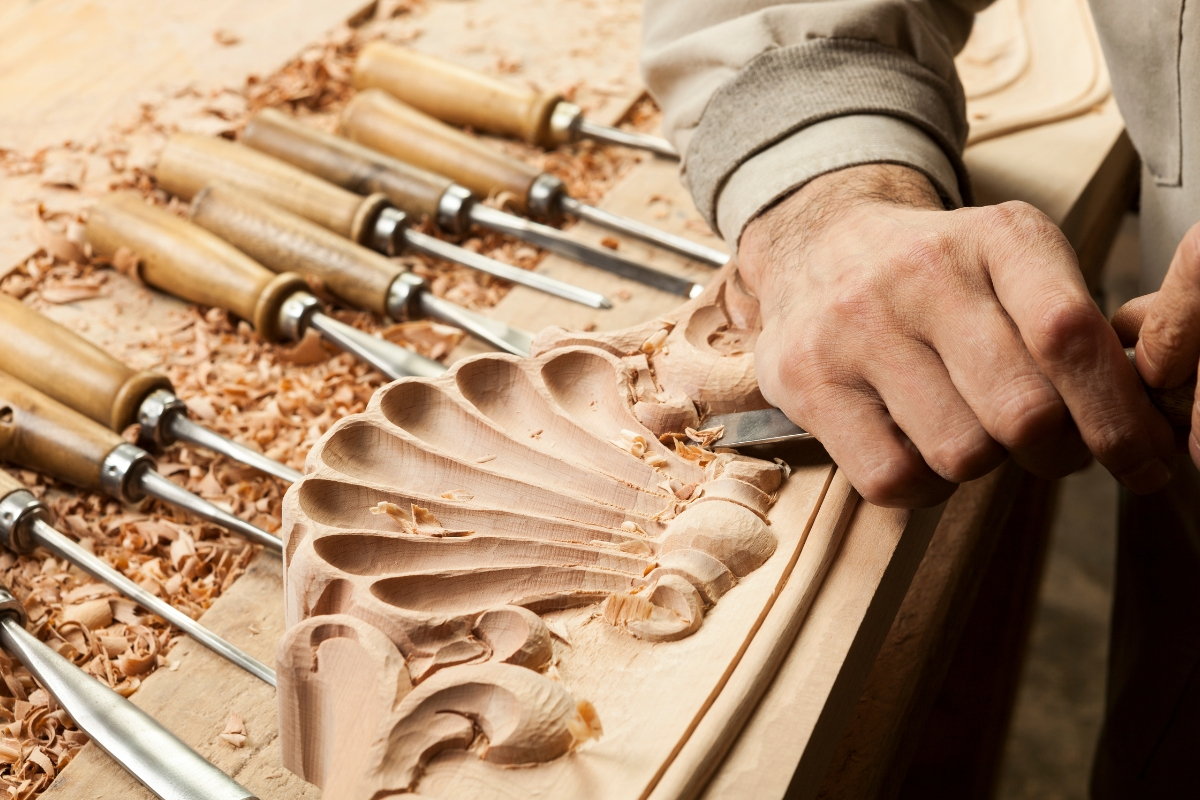
Wood carving is not just about “cutting wood.”
There are various techniques and styles.
Relief carving
The design is created on a flat surface and gains depth as wood is removed from around and within it.
Chip carving
Small, controlled cuts create geometric or decorative patterns on the wood’s surface.
Whittling
This is the most minimalist form of wood carving, typically involving the use of a carving knife to create small objects and figures.
Wood carving
In this form, wood can be transformed into more complex, three-dimensional shapes—ranging from human figures and animals to abstract sculptures.
Wood carving is not a hobby to be rushed.
An incorrect cut can alter the design or remove more material than intended. This requires patience, precision, and control of movement. At the same time, you need to observe the wood grain—the direction and pattern of its fibers. The direction of the fibers significantly influences how the tool glides through the material. In this way, what begins as a craft can almost turn into a focused exercise in concentration. Every movement must be calculated.
Can someone start without any experience?
Absolutely! In fact, wood carving is one of those hobbies where you don’t need to know how to draw or have any prior experience to get started.
In a beginner’s course, you can first learn how to hold the tools correctly, make basic cuts, and understand how wood behaves. Afterward, you can move on to a small project. Don’t start with something that requires 40 hours of work. A small object that you can complete in just a few sessions is a much better starting point—because seeing your first finished project is what will motivate you to take on a second one!
Wood carving takes time. It’s not a hobby that yields results in five minutes.
In a world where everything happens quickly, this craft invites you to slow down, observe the material, work with your hands, and let the result take shape step by step.
At HobbyDetective, you will find wood carving classes, workshops, and instructors, as well as many other creative activities to help you learn something new.
HobbyDetective Spain is preparing its community and experiences. Explore what is coming next. HobbyDetective
Your first step in Spain
Look for an introductory session at workshops or cultural centers in your municipality. Compare the techniques being taught, the materials included, the group size, and whether you will be able to complete your piece during the class. If you want to practice at home, start with a small project and buy only the materials you need; always check the manufacturer’s instructions, as well as the proper ventilation and safety gear required for each product.
Original article: 2026-09-17. Edition adapted for Spain: 27 October 2026. Read the Greek original. Original author: Eleni Agiou.